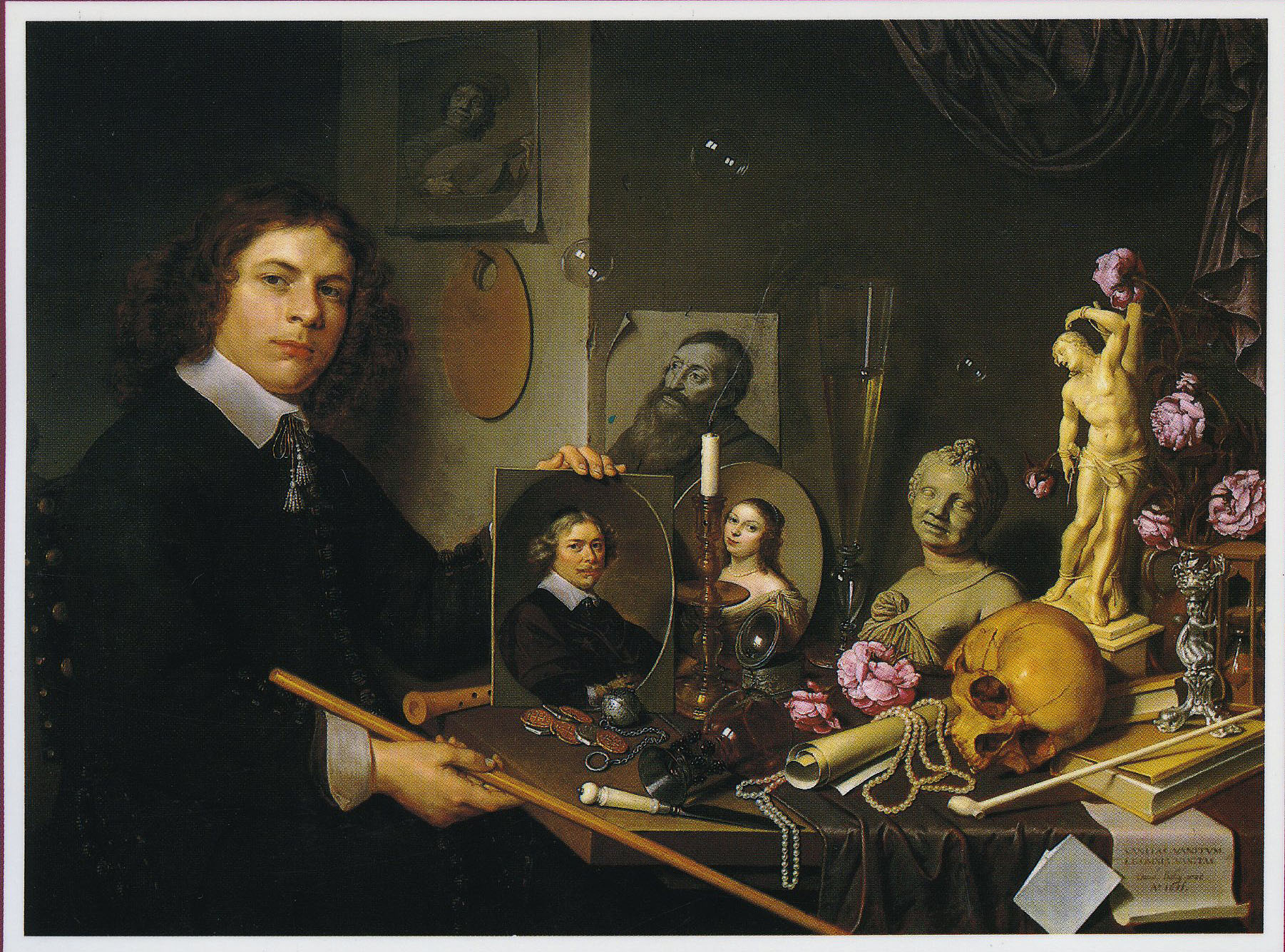
D. Bailly, Still Life, 1651
The Dutch present their pictures as describing the world seen, rather than as imitations of significant human action. Already established pictorial and craft traditions, broadly reinforced by the new experimental science and technologies, confirmed pictures as the way to new and certain knowledge of the world.
Svetlana Alpers
The groundbreaking book by art historian Svetlana Alpers, The Art of Describing: Dutch Art in the Seventeenth Century, is a valuable point of departure for understanding Dutch documentary photography in the late 20th century. An essential concept of her analysis is that critics of Dutch painting, such as Wolfflin and Panofsky, judged Dutch painting according to the tenets of Italian art (i.e. academic art) and disregarded the cannons of the “northern artistic tradition”. As Alplers states, ” a major theme of this book is that central aspects of seventeenth century Dutch art – and indeed the Northern tradition of which it is based – can best be understood as being an art of describing as distinguished from the narrative art of Italy.”
Svetlana Alpers’ argument is based on the fundamental viewpoint that “in Holland the visual culture was central to the life of the society. One might say that the eye was a central means of self-representation and visual experience a central mode of self-consciousness. If the theater was the arena in which the England of Elizabeth most fully represented itself to itself, images played that role for the Dutch.” Given the importance of the image in Dutch culture, it is not difficult to see how the Dutch art form might have evolved around the act of description. Another related concept presented by Alpers is that there was a fully developed social structure around the crafts in Dutch society. It was within this milieu in which Dutch painting developed, one in which craft, skill and technique were paramount. Alpers presents a number of other characteristics of Dutch painting including; a frequent absence of a positioned viewer, a play with great contrasts in scale, the absence of a prior frame, a formidable sense of the picture as a surface and an insistence on the craft of representation.
There are, of course, criticisms of Svetlana Alpers’ conceptualization of the Dutch pictorial tradition, not the least of which is that by presenting Dutch culture as “independent of and at a distance from language”, there are few texts which can be used to directly support her theory (Ivan Gaskill). Others suggest that Alpers neglects narrative aspects of Dutch culture and that her Holland is a “Holland without philosophy, without a classical tradition, without humanism”. In the end, despite these criticisms, even her critics suggest that she has created “an original and provocative contribution to the literature of cultural history “(Anthony Grafton). While Alpers’ argument is about seventeenth century Dutch painting, she suggests that while photography was invented almost two hundred years later, “it is properly seen as being part of this descriptive mode, rather than being seen as the logical culmination of the Albertian (i,e, Italian) tradition of picture-making”. Given that description is an essential part of the ontological meaning of photography, it will be interesting to explore in what ways, if any, the Dutch cultural pre-disposition for the descriptive mode might relate to the development of contemporary Dutch photography.
Categories: Uncategorized
 petercoolsen