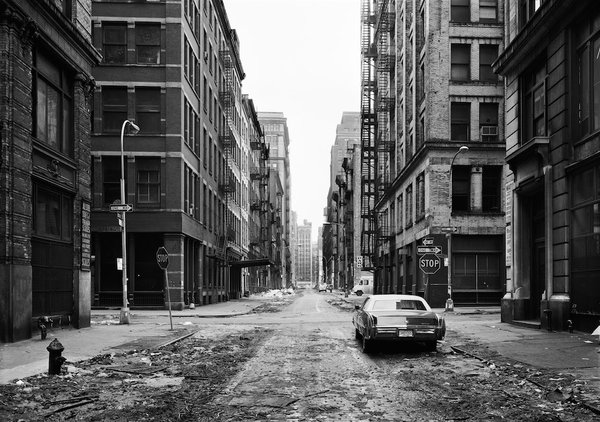
Crosby Street, Soho, New York, 1978
In Janna Prikryl’s 2014 review of Thomas Struth’s retrospective exhibit at the Metropolitan Museum of New York, Thomas Struth: Style Without Style, she presents an interesting case study of a fine art photographer making the transition from post-modernist (film-based) photography to contemporary (digital) photography. In reviewing the evidence in her article, one may ask, “In what way, if any, has Struth’s photography changed during this technological evolution?”
Analogue Photography
Prikryl’s examples of Struth’s early, film-based work are based on a review of his black and white photographs, mostly small cityscapes, taken in 1978 in New York City. These early cityscapes contain post-modern elements reflective of his work at the Dusseldorf Kunstakademie and his tutelage under Berne and Hilda Becker, whose unique mode of photography has been described as using “photographic precision to show essential things” (Aperture). The central idea in their work is that of objectivity. This is accomplished thru a number of strategies including; uniform lighting, a straight forward vantage point and “systematic composition of each picture”. In direct reference to the Bechers, Struth’s 1970 black and white photographs are “strictly composed streetscapes, always from the same symmetrical perspective, in the middle of a street looking down to its vanishing point and early in the morning so the scene would be deserted” (Prikryl). Struth used this same method in photographing some fifty cities worldwide. Another element of Struth’s early work is the strict emphasis on the non-aesthetic. As Struth related to an interviewer during this period, “I’m interested in photographs that have no personal signature”. Or, as Prikryl suggests, regarding Struth and his New Typographic contemporaries, their pictures were perceived by many as expressing a “blank refusal to betray any hint of lyricism or straightforward beauty” and achieved a documentary quality that seemed “drained of emotion”.
Digital Photography

Corso Vittorio Emanuell, Naples, 1989
During the 1980’s, at the advent of digital photography, Thomas Struth’s work moved away “from a more conceptual approach toward larger formats, and from symmetry toward freer compositions”. “The images turn to color; grow enormous, more tranquil, and more fearless about picturing grandeur” (Prikryl). Perhaps this is the most significant change in Struth’s photography under digital capture. That is, his images moved from the intimate, made-for-books photographs to the grand, five foot by six foot images that were made-for the-wall. While elements of his earlier work are still present (.e.g. his impeccable technique and impersonal style), the later images are presented in a significantly different manner.
Interestingly enough, in spite of the potential for manipulation in digital photography, Struth resisted the “lure of manipulation” in his digitized photographs and “stayed faithful to the scenes he presents” (Mead). It is, however, too simple to suggest that size alone represents the primary shift in his imagery. What digital capture seems to have impacted the most is the expansion of Struth’s vision and of his ability to demonstrate much more complexity, splendor and technical accomplishment in his large-scale photographs.
A Second Look: “Style without Style”
In addition to tracing the transition in Struth’s photographs from the analogue to the digital era, Janna Prikryl makes surprising comments regarding the relationship of Thomas Struth’s work to aesthetics. In spite of his espousal of near total objectivity, Prikryl argues that “it is impossible to ignore the formal beauty” of his photographs and that, instead of “cool objectivity”, she sees a sense of “profound human curiosity” in his early work. In terms of Struth’s large-scale images, such as Corso Vittorio Emanuele, Naples, 1989, Prikryl argues that “the inundation of the frame, the ampleness of what is shown of these massive apartment blocks and dim back alleys, somehow generates a sense of warmth, rather that the chill you might expect”.
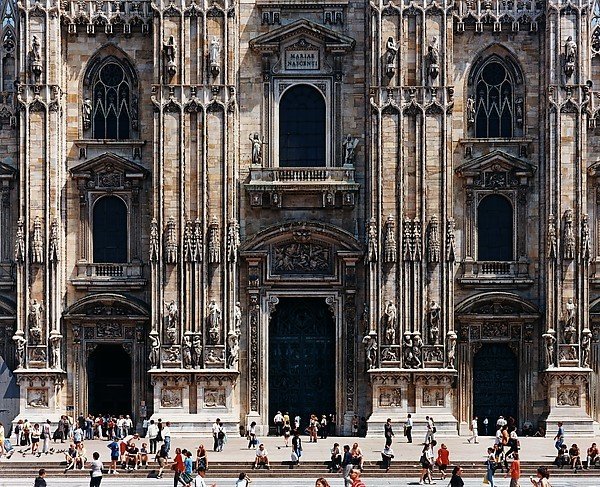
Milan Cathedral, Milan, 1998
We see this quality reflected, again, in Struth’s Milan Cathedral, Milan, 1998. In this image, the life-size statues on the façade of the cathedral seem to form a relationship with the tourists on the steps. It is hard to tell if the ancient statues are looking down in dialogue with the tourists or, “is it the tourists who are addressing the statues?” It seems, from this analysis, that the abandonment of beauty (aesthetics) by Thomas Struth may not be quite as evident as he suggests. Or, as Prikryl notes, “what expressive a style is available within an approach that aspires to be neutral”. Perhaps, and fortunately so, no matter how objective a photograph aspires to be, there is always a chance of “beauty raising its ugly head”.
Sources
Jana Prikryl, Thomas Struth: Style Without Style, New York Review of Books, NYR Blog, January 28, 2015
Between Past and Future: New German Photography, Aperture. Spring, 1991
Andrew Mead, Thomas Struth: Photographs 1978-2010, Whitechapel Gallery, London, 27 July, 2011
Categories: Uncategorized
 petercoolsen