“ When and where the subject of the photograph is a person who has suffered some form of injury, a viewing of the photograph that reconstructs the photographic situation, and allows a reading of the injury inflicted on others, becomes a civic skill, not an experience in
aesthetic appreciation”.
Ariella Azoulay
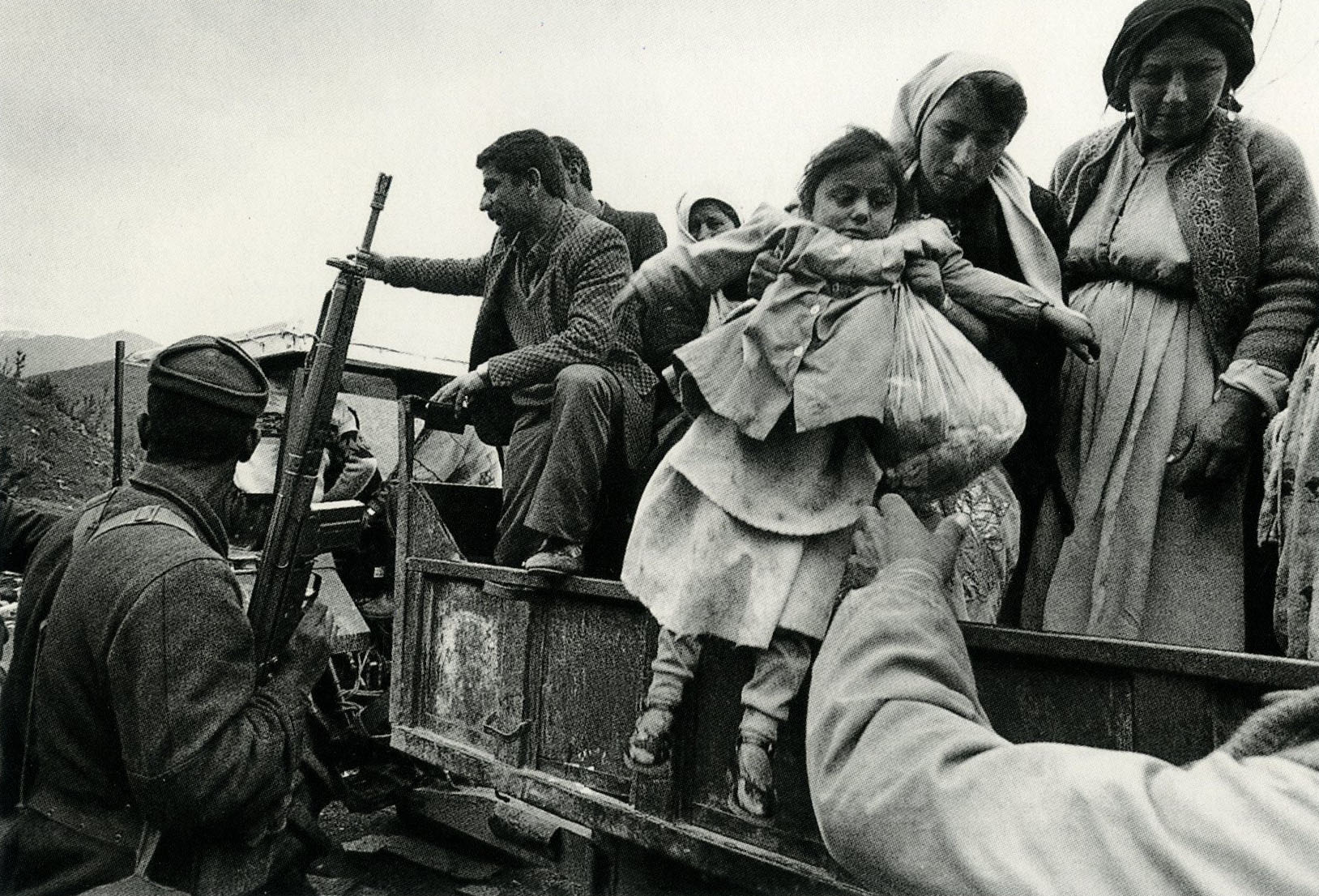
Kurdish Refugees, Liliana Nieto del rio
In her introduction to The Civil Contract of Photography, the photographer and critic, Ariella Azoulay, presents her tightly-woven argument about the nature of the photo-documentary genre and about what she refers to as the “civil, political space” shared by photographers, spectators and photographed people. Her treatise reflects her experience as an Israeli (born to an Arab father) living in Israel and photographing in the Occupied Territories. As suggested in the title to her book, Azoulay posits a “civil contract” to be invoked when photographers photograph others, particularly when they take photographs of those who have suffered “some form of injury”.
The Civil Spectator
Ariella Azoulay posits a central character in the photographic event, which she refers to as the “civil spectator”. This is someone who has the ability to not just look at a photograph, in a casual or disinterested way, but who is able to “watch” photographs, or, one might say, witness photographs and ultimately take on a duty in response to them. The prism through which Azoulay views the subjects of her photographs is the concept of “citizenship”. In her view, “while all citizens are governed by a ruling power, the political duty of the governed is first and foremost a duty toward one another, rather than toward the ruling power”.
For Azoulay, this concept of universal citizenship is critically important in understanding the status of the Palestinian people, living under years of Israeli occupation as “non-citizens” in their own land. This concept resonates with other documentary photographers such as Susan Meiselas and Josef Koudelka, whose work in photographing occupied citizens in Czechoslovakia, Kurdish refugees attempting to enter Turkey or marginalized citizens of the Roma population of Europe, takes a similar position.
The Civil Contract
Azoulay traces the origins of the concept of the “civil contract of photography” to the emergence of the nation-state in the 18th century, Jean-Jacques Rousseau’s writings on the concept of “social contract” and the French Revolution (all events which took place around the time photography was invented). She states that “the relations between the three parties involved in the photographic act – the photographed person, the photographer and the spectator- are not mediated through a sovereign power and are not limited to the bounds of a nation-state or an economic contract”. In formulating her hypothesis, Azoulay criticizes the late Susan Sontag who, in her book Regarding the Pain of Others, places the emphasis in the “photography of others” on photographer and spectator, leaving out the central player in Azoulay’s trilogy, the subject(s) of the photograph. A second facet of the prism through which Azoulay views photography is what she perceives of as the “impaired civic status” of women, both in the Occupied Territories and elsewhere around the world. As a result, much of the focus of her documentary photography addresses this issue.
Michael Fried and Ariella Azoulay: Disparate Views of Photography
It is, perhaps, instructive to compare the differences between Ariella Azoulay’s view of the ontological nature of photography, as presented in The Civil Contract of Photography, with that of the critic Michael Fried, as argued in his book Why Photography Matters as Art as Never Before. Fried is concerned with photography as fine art and Azoulay with the ethical and social implications of photography. While they both reject aesthetics as the organizing principle of photography, they have very divergent views concerning the spectator of the photographic image. Michael Fried proposes a “distance” between spectator and the photograph. As Noam Leshem and Lauren A. Wright suggest in their review of Fried’s book, “photography matters as art, for Fried, precisely because as art it need not, indeed must not, require us to respond, because we are not directly addressed”. In stark contrast to this, Azoulay not only places the subject in the equation, but also suggests that photographs place a moral demand on the spectator to become engaged.
While it can be said that both Fried and Azoulay make compelling arguments about the ontological nature of photography, it seems that neither “makes a better general claim for photography as a whole”. Photography is a very diverse medium composed of multiple forms that both share common elements and are separated by their differences. What is important is that every form of photography (e.g. fine art photography, photojournalism, documentary photography, descriptive photography, commercial photography etc.) has a different purpose and, as such, a different place in the totality of the photographic medium.
Categories: Uncategorized
 petercoolsen