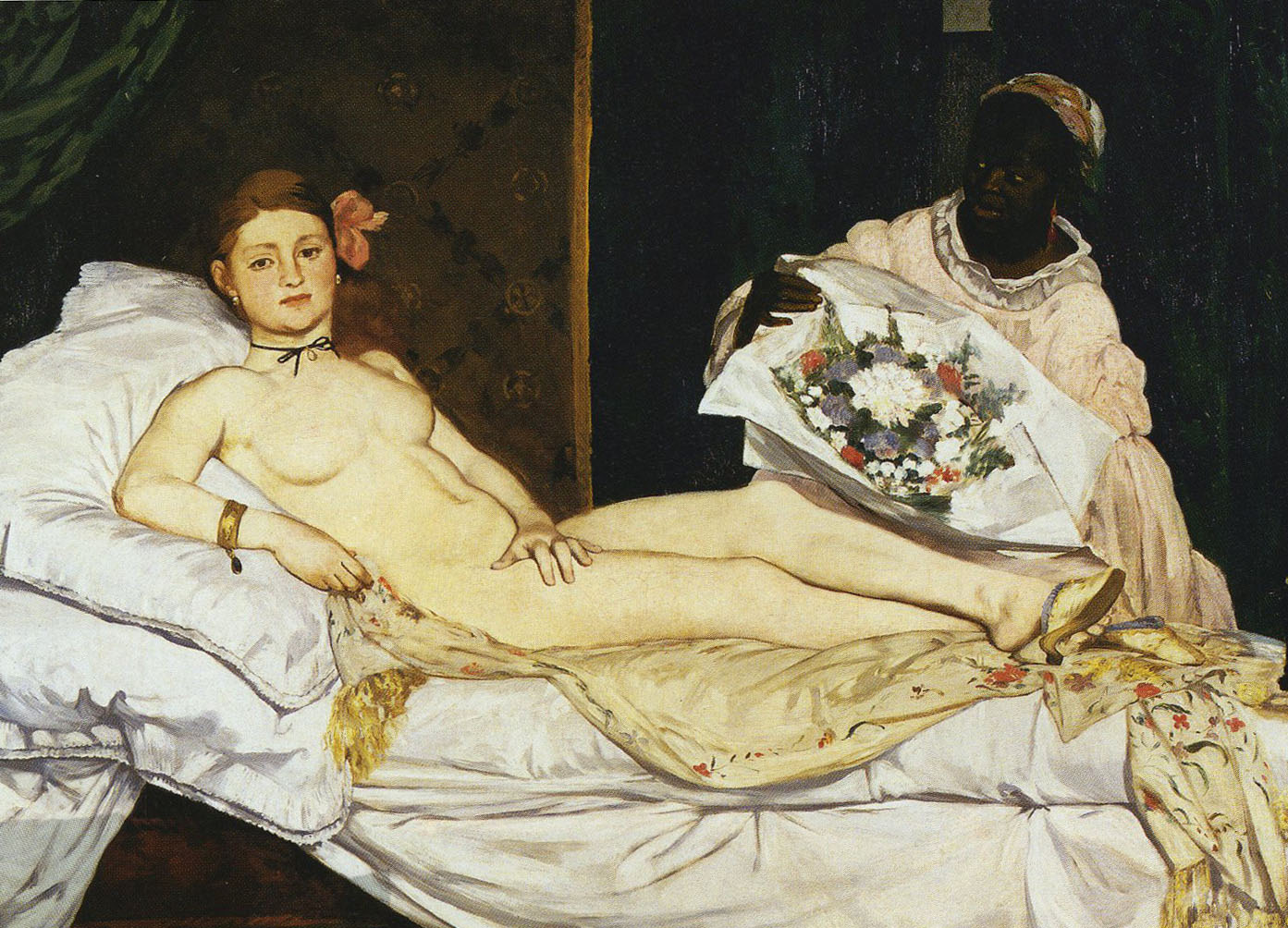
Edouard Manet Olympia (1843)
Manet’s Olympia is depicted (shockingly, for the time) fully naked as a contemporary courtesan, yet her expression is blank and her body is rendered flatly, expressly painted rather than ‘real’. The effect is to further distance the viewer.
Noam Leshem and Lauren A. Wright
Why Photography Matters as Art as Never Before, by Michael Fried, philosopher, art historian of the French anti-theatrical tradition, and, more recently, critic and theoretician of contemporary photography, is an expansive, highly detailed analysis of what his book’s reviewers call, “spectatorial relations in recent art photography”. The book covers the work of over fifteen contemporary photographers which Fried uses to demonstrate his ideas about the relationship of the viewer with photography. This article briefly summarizes the review of Fried’s book, by Noam Lesham and Loren A. Wright, and integrates an overview of the first chapter of the book, entitled Three Beginnings, with the book review.
Michael Fried’s thesis is that a dichotomy exists between, what he calls, the “realist intimacy” expressed in photographic practices prior to the 1970’s and “a much more public and explicitly ‘artistic’ form of contemporary photography”, which his reviewers refer to as “grandiloquent artifice”. The grandness of the “more public form” of contemporary photography refers, in part, to the large-scale, “tableau” photographs, described by Fried as having been produced “for the wall”. Here Fried is not referring to photographs made just to be hung on gallery walls, but, rather, photographs which are made large enough to take up most, if not all, of the gallery wall. These large photographs are a relatively recent phenomenon in contemporary photography, made possible because of the ability of digital photography to produce images of enormous size (compared to traditional photographs) while retaining high detail.
Extending his use of dichotomy in discussing art, Fried refers to the two “opposed tendencies” in art between 18th and 19th century French paintings, tending towards “theatricality”, and late 19th and early 20th century French paintings, characterized by a tendency towards “absorption”. The watershed moment in this opposition, according to Fried, is the appearance of Edouard Manet’s Olympia in 1843, a painting which challenged the artistic status quo of the French salons and artistic establishment. Fried uses this analogy, taken from the conventions of painting, to discuss the fundamental changes in art photography 130 years later.

Lenka Ryan H Unexpected, 2003
Two concepts critical to Fried’s theory, that are demonstrated in Manet’s Olympia; are “distance” and “absorption”. The subjects in Fried’s “explicitly artistic form” of photography are most often unaware of the camera and, as such, place the viewer at a psychological distance from the image.
In Chapter 1 of Field’s book, he addresses what he calls the “three beginnings” which marked the shift in photography in the late 1970’s and 1980’s, when photographs were beginning to be made at large-scale, “for the wall”. The first beginning relates to three photographers who, responding to the influence of movies, “engaged cinema head on”; i.e. Hiroshi Sugimoto with his black and white photographs of movie theaters, Cindy Sherman through her “Untitled Film Stills” and Jeff Wall in his early work with Movie Audiences. All three photographers showed their subjects to be in “a state of absorption”.
Fried’s second beginning in the shift of the medium towards the “new regime of art photography”, relates to the work of Thomas Ruff, Jean-Mark Bustamente and Jeff Wall, who in the making of their photographs, intended to have them printed large-scale and in “tableau form”. This phenomenon was demonstrated by Jeff Wall in his Lightbox Series, Thomas Ruff through his “passport style” color portraits and Bustamante in his early Tableaux Series.
The third of the beginnings of this new form of photography, Fried states, is based not on painting or photography, but, on three texts; an 18th century French tale, a Japanese text published in 1970 and Susan Sontag’s writings, particularly Regarding the Pain of Others, published in 2003. The concepts of “truth of expression” and the quality of “unawareness” of the subject towards the intrusion of the camera are critical here. In addition, primarily through Sontag, the question of ethics regarding photographs of painful subjects such as the victims of war and misfortune come into question. Michael Fried presents a number of pivotal concepts, often in opposition to each other, which are critical to understanding his thesis about contemporary photography including; theatricality and anti-theatricality, self-control and vulnerability, absorption, tableau, physical presence, aesthetic distance and to-be-seenness. All of these concepts are discussed in the remaining chapters of his book and, understood in their totality, are used to persuade the reader that “photography matters as art as never before”.
Categories: Uncategorized
 petercoolsen